
E365 Construction
The complete main-contractor system inside Business Central — from tender to final account, with a cost-value reconciliation engine built to run hundreds of projects at once.
Tendering & estimating · subcontracts, CIS & retention · valuations & milestone billing · CVR forecasting · SHEQ
Most contractors run their commercials outside their ERP
The estimate lives in one spreadsheet, the CVR in another, subcontract retentions in a third, and the finance system only finds out at month end. E365 Construction closes that gap by putting the whole commercial cycle where the ledger already is.
The spreadsheet spiral
- ×CVR rebuilt by hand every month, project by project
- ×Commitments guessed at, because open orders are hard to total
- ×Retention and CIS tracked in a separate ledger nobody trusts
- ×Finance and commercial arguing about whose numbers are right
- ×No audit trail when a forecast quietly changes
With E365 Construction
- Forecasts generated for every live project in one batch
- Committed cost calculated from real open orders
- Retention and CIS handled in the certification cycle itself
- One set of numbers, traceable to the job ledger
- Locked, immutable versions and mandatory movement reasons
Tender to final account, in one system
Six connected modules covering the whole commercial lifecycle of a main contractor.
Preconstruction & estimating
Tender register with a full bid pipeline, estimate revisions that are locked once submitted, prelims, overhead and margin build-up, and subcontract RFQ packages with side-by-side adjudication.
One-click award to project
Winning a tender creates the project, a task per cost code, the locked baseline budget and draft subcontract orders for adjudicated packages — in a single action.
Subcontracts, retention & CIS
Subcontract orders with retention terms, the application → certificate → invoice cycle, CIS deduction by verification status, a full retention ledger and release routine.
Client billing, both ways
Monthly valuations for measured work, or milestone billing for fixed-price and design-and-build contracts — both posting identically, with retention receivable tracked to release.
The CVR forecasting engine
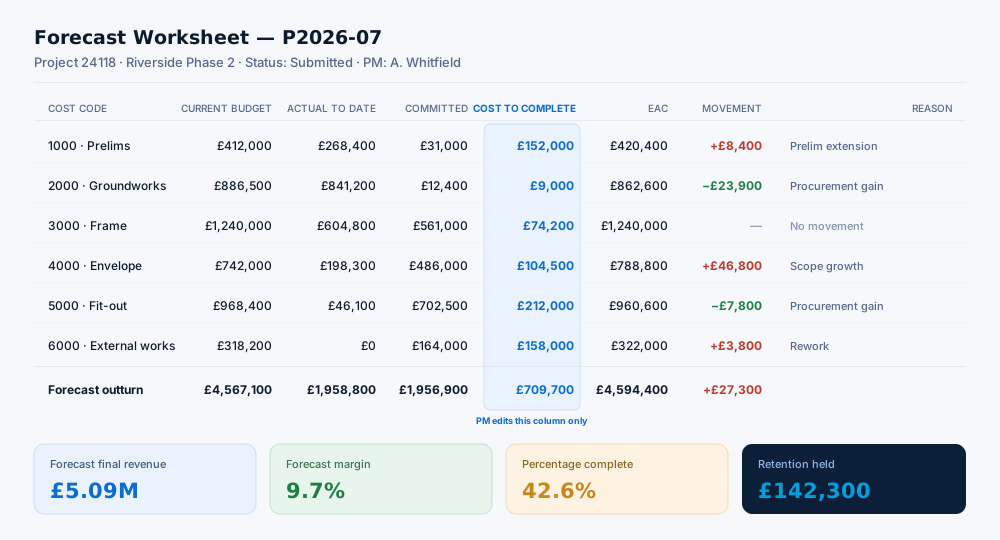
Versioned cost-value reconciliation at cost-code level. Budget, actuals and committed cost are machine-populated; the PM edits one number — cost to complete.
SHEQ that actually enforces
Incidents with RIDDOR flagging, inspections that auto-raise corrective actions, an operative competency register, NCRs, permits and snagging — all keyed to the project.
A CVR that maintains itself
Every forecast line is machine-populated from the ledger and the order book. The project manager supplies one figure — cost to complete — and everything else follows.
Approved versions lock permanently, giving a clean month-on-month margin bridge and an audit trail of every movement and the reason behind it.
Designed for the way contractors actually work
Built on the principle that if a number can be derived, nobody should be typing it.
Everything reconciles to the ledger
Cost reaches a project through posted documents only. Every figure in the CVR traces back to a job ledger entry or an approved forecast version — there is no side system to reconcile.
Built to survive hundreds of projects
Forecasts roll forward automatically at period end, so a project nobody touches still produces a complete, defensible position. A stable project costs the PM almost no time at all.
The cost code is the atom
One company-wide cost code library drives estimating, buying, forecasting and reporting. Estimate codes, project tasks, forecast lines and Power BI rows all line up by construction.
Approval by exception
Reviewers see only the forecasts that moved beyond tolerance, each with a mandatory movement reason — so the monthly review covers the twenty projects that matter, not all three hundred.
PMs can stay in Excel
Edit forecasts directly in Business Central, round-trip through native Edit in Excel, or bulk-upload one spreadsheet covering forty projects through the import journal.
Compliance with teeth
Lapsed insurance, CIS status or an expired mandatory operative certificate blocks that subcontractor’s certification — the one enforcement subcontractors reliably respond to.
The monthly rhythm
Set up once, then the cycle largely runs itself.
Set up your cost codes
Build the company-wide cost code library and WBS templates once. Everything downstream keys off it.
Bid and win
Run tenders and estimate revisions, adjudicate subcontract packages, then award — which builds the project, baseline budget and draft subcontracts automatically.
Run the month
Post timesheets, subcontract certificates and invoices. Actuals and committed cost flow into the forecast on their own.
Forecast, approve, report
Generate forecasts in one batch, PMs set cost to complete, approve by exception, then lock — driving percentage-complete revenue recognition and the margin bridge.
Standard BC first
A few deliberate design decisions shape how E365 Construction fits alongside what you already run:
- Built on the standard Projects (Jobs) module, purchasing, resources, dimensions and the G/L — E365 Construction extends Business Central rather than replacing it.
- UK-first: CIS deduction by verification status, CIS300 return data, retention conventions and JCT / NEC contract forms.
- Written for the main contractor’s perspective — downstream subcontract management and retentions payable, with client valuations and milestone billing alongside.
- Locked forecast versions are immutable, giving clean month-on-month margin bridges and a complete audit trail.
See E365 Construction on your own numbers
Tell us how many live projects you run and how your CVR works today, and we’ll walk you through what the monthly cycle would look like in Business Central.